 damien@damienkee.com
How fast does a fidget spinner spin? – Damien Kee
 Sep 13, 2017

In this tutorial, I’ll show you how to use the LEGO MINDSTORMS EV3 datalogging capabilities to measure how fast a fidget spinner spins.
I use a Colour Sensor in reflected Light Mode, positioned above one of the lobes of the spinner. When the sensor is pointed directly at table, it gives a high reflected light reading, however, when one of the lobes of the spinner passes under the colour sensor, the reflected light readings change. By measuring the time between each lobe passing under the sensor (and taking into account there are three lobes) the rpm of the spinner can be calculated.
I set the Experiment up to run for 10 seconds, and to take 1000 samples per second. The spinner is moving pretty quick so we want to grab as much data as we can.
After we run the experiment, we upload the data and get the following:

If we zoom in on the data, we can clearly see the lobes of the spinner as they pass under the Colour Sensor.

The first part is before we get the spinner spinning. By zooming in on some data, we can clearly see how the spinner reflects different amounts of light depending on what is directly under the Colour Sensor. I was surprised at how clearly you can see the various parts of the spinner. You can clearly see the silver parts of the bearing nestled inbetween the black moulded plastic.
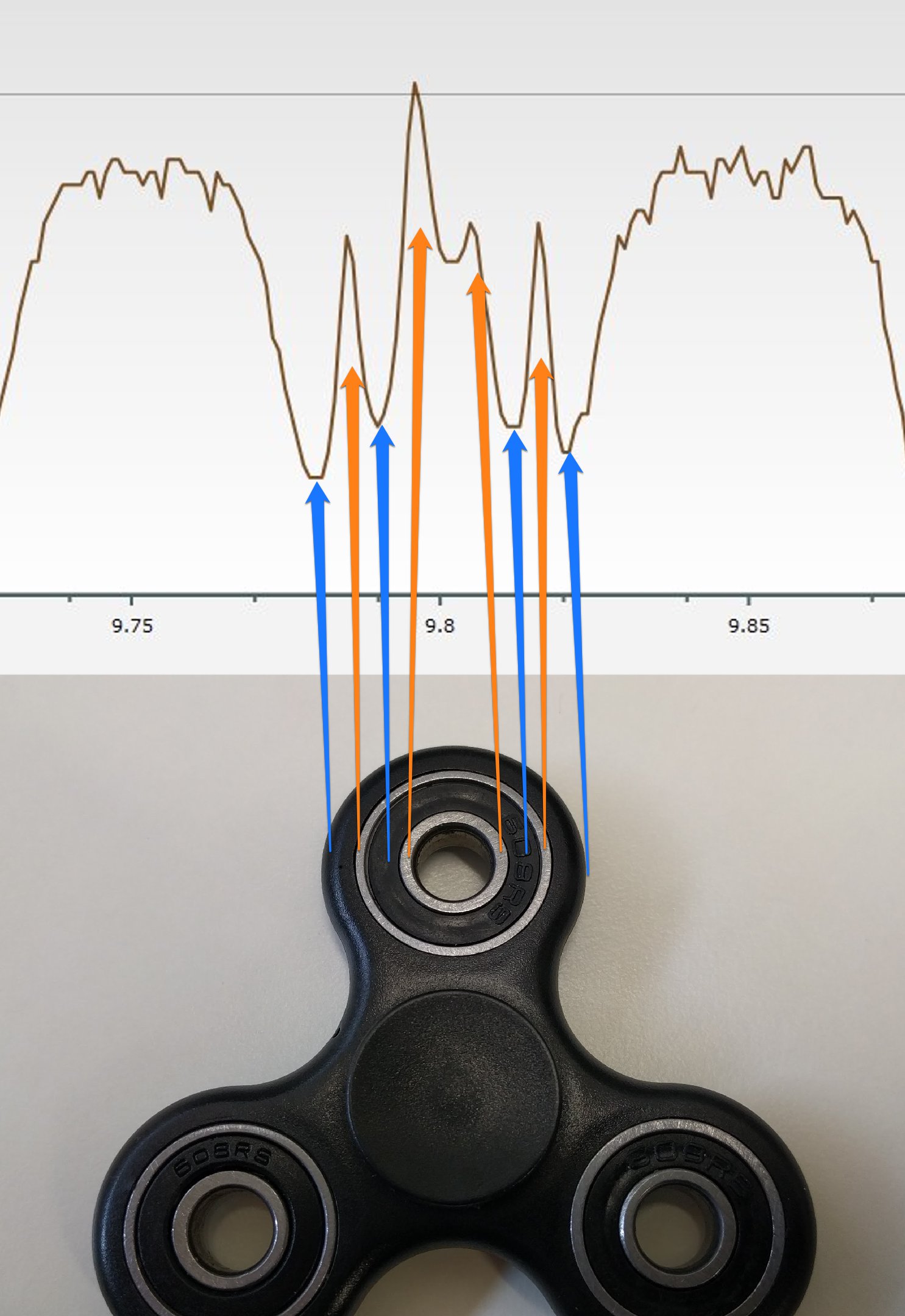
Click for larger version
By measuring the time between any two common locations on the graph, you can calculate how fast one lobe of the spinner goes past. Keeping in mind that there are 3 lobes on my spinner, you can calculate the rpm of the spinner at different times.
By using the analysis tool, we can measure how long it takes the spinner to do one spin. You’ll note I’ve taken the first ‘high’ part of the graph, where the spinner sees the white table, and then again at the 4th ‘high’ part. This is because there are 3 lobes of the spinner.

You can see that the start of my section crosses the x-axis at 2.16 seconds, and ends at 2.30 seconds. This gives a time of 0.14 seconds per revolution.
To convert into revolutions per minute (rpm) we divide 60 by the time for 1 revolution. 60/ 0.14 = 428 rpm.
I calculated the speed at the start and again around 8 seconds after it had started spinning. My spinner went from 428 rpm to 215 rpm during this time.
This would be an awesome experiment in class as it would be possible to see the relative slowdown between different types of spinners.